
AI Agents at Work: The Security Gaps Enterprises Can’t Afford to Miss
- J. Nacol and AI Assisted Research
- Apr 4
- 2 min read
Updated: Apr 10
Today’s AI agents can query data, call APIs, trigger workflows, and take action across production systems with limited human intervention. For CISOs, CIOs, and AI strategy leaders, that shift creates a new security challenge. Once an AI agent can act inside enterprise environments, it becomes more than an application feature, it becomes part of the operational control plane.

The Security Gaps Enterprises Are Missing
The biggest risks often do not come from the model alone. They come from the integration layer around it: identities, APIs, orchestration tools, cloud roles, and data flows.
Three gaps are showing up repeatedly:
Non-human identity and excessive privilege
AI agents often operate with broad access to cloud services, internal applications, SaaS platforms, and enterprise data. If those permissions are over-scoped or poorly segmented, an agent can become a path for lateral movement or unauthorized action.
Indirect prompt injection and unsafe tool use
Agents can be manipulated through the content they consume. A malicious instruction hidden in an email, document, webpage, or ticket may influence the agent’s reasoning and lead to unintended API calls, data access, or workflow execution.
Autonomous data exfiltration through legitimate channels
Agents may move or expose sensitive data through approved APIs and sanctioned cloud workflows. To legacy security tools, that activity can appear normal even when it violates policy or intent.
Why Human-Centric AI Is a Security Control
Human-centric AI is not just a governance principle. It is a practical security control.
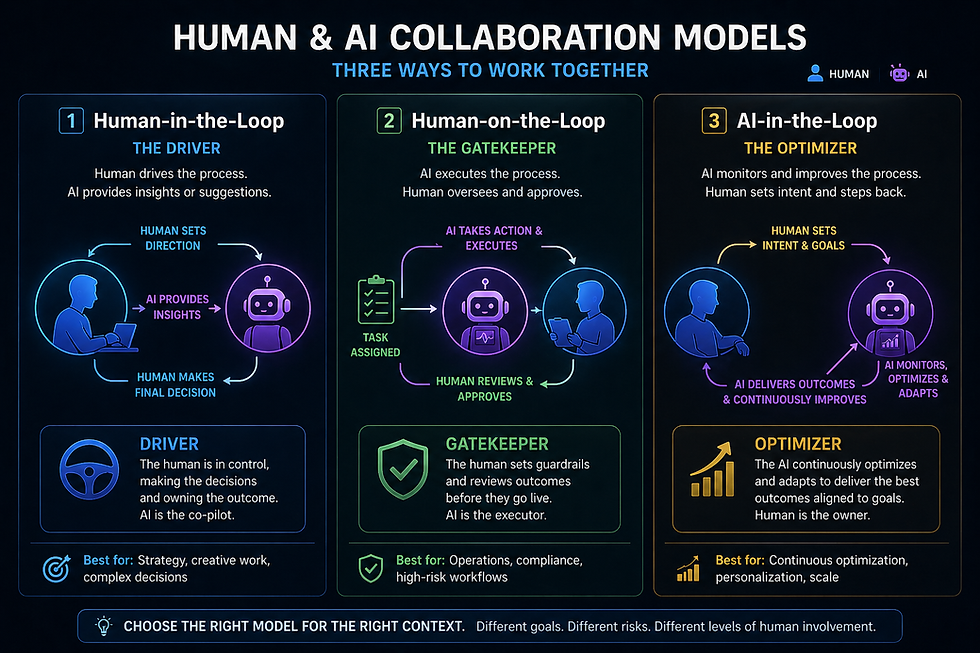
In enterprise environments, agents can accelerate analysis, coordination, and low-risk execution. But authority over sensitive actions should remain bounded by human approval, policy constraints, and clear operational limits.
That matters because the core security question is not whether an agent can act. It is where autonomy must stop and accountable human control must begin.
What Secure Deployment Requires
A secure AI-agent architecture should include a few core controls:
Treat agents as privileged non-human identities - Scope, authenticate, and monitor them accordingly.
Use just-in-time, task-bounded access - Avoid persistent broad privileges and limit access to the minimum required for each workflow.
Constrain tool use and execution paths - Agents should only be able to use approved tools within defined boundaries.
Log decisions, not just events - Security teams need visibility into what the agent was asked to do, what context it used, and why it took action.
Keep humans in the loop for high-impact actions - Infrastructure changes, sensitive data movement, financial transactions, and external communications should require explicit human approval.
The Di1 Perspective
At Di1, we view agent security as an integration security challenge as much as an AI challenge. The real risk emerges when models are connected to enterprise systems, cloud control planes, data sources, and automation frameworks.
AI agents can create real business value, but only when autonomy is matched with guardrails. That requires secure digital integration, strong identity design, multi-cloud governance, and human-centered control.
That is how enterprises can scale AI safely without sacrificing security, accountability, or trust.
Comments